
Thursday, December 16, 2010

Wednesday, December 15, 2010
Designing new creative writing classes
 |
| Yeah, so this is another video game pun. Sorry guys. |
I feel at times as if our creative writing curriculum, at both the undergraduate and the graduate level, has passed from the point of codification to calcification. You've got your workshops (prose, poetry, or nonfiction, maybe drama, BUT NEVER THE TWAIN SHALL MEET), you've got your craft classes (what we call form and technique at NMSU; I'm curious how these work elsewhere), you've got your classes that are actually for lit credits but a CW instructor leads the class, you've got the occasional class on publishing a magazine (read: you manage the university lit mags slush pile) or bookmaking (arts and crafts). There are some other things but this is really the main of it.
I wonder sometimes about how we might revitalize our writing and our feeling of community by considering entirely new classes. Here are some rough ideas for new classes. Maybe you would like to teach one of these? Maybe you would like to do it through the blog? I bet that would be fun.
Research for Writing
This is one of my perennial obsessions. When I was in undergrad I majored in journalism for a while on the assumption that at some point someone would teach me how to do some damn research. This never happened. They occasionally sent you out to interview somebody or write about a speech, and eventually I was going to learn how to walk into a police station and look at official police documents (dangerous! subversive! truth-telling!) but they were clearly never going to tell me how to actually discover if something was true or not so I quit the major and never looked back. The English major helped with this a little but mainly I know how to search JSTOR.
What I want is a class that teaches me how to find useful sources that will tell me practical information for fiction and essays alike. So for instance in my thesis there's a section toward the end that takes place in a big store. I needed to know what would be in that store in the '50s but I wasn't sure how, so I named a bunch of products that felt plausible to me and some of them were right and some of them were pretty wrong. So in workshop the instructor suggested I look at old catalogs. And I was like, "OF COURSE." I want a class that helps with stuff like that, and teaches as many other methods of rigorous and esoteric research as possible, from the perspective of the needs of fiction and nonfiction writers. I would love to teach this course (and in so doing, presumably, to learn enough to know HOW to teach it.) I would love to take it.
Blogging 101
Okay this is maybe not a CW thing so much as a writing thing generally but it's inevitable at this point that people will begin to teach blogging. Of course there are already courses on this subject in many places, but I've never personally seen one, and I haven't generally gotten the impression that they focus very much on practical ideas of how to build an audience, how to develop a specialty, how to interact with other blogs, how to add value, etc. I would like to teach this course though I'm not sure I'm that good of a blogger.
Book Design
So you see a lot of classes about making cool books in terms of binding and fancy perfume samples or whatever but how about a class where I become intimately familiar with InDesign? How about something where they teach me how to communicate productively with a printer? Again, I'm sure this is out there but I've never had the chance to take it.
Principles of Entertainment
Right now we spend a lot of time talking about how "good writing" works. However, this disguises the fact that there are many, many kinds of good writing. There are, however, relatively defined and concrete ways of entertaining readers; not necessarily in a crass sense, but in the same way that there are clear principles of good game design or etc., there are clearly fundamental strategies that produce fun: the unfolding of a structure, learning rules, learning about a character, learning about a world, and so on. The goal would be to leave aside good writing as a subject for a moment and focus on writing that demands, by its structure, to be read. The theory being that this sort of writing will often ultimately be quite good as well, but in unexpected ways.
Economics and Practice of Writing
A lot of schools are resistant to discussing this, either because they find it crass, depressing, or pointless (i.e., they don't believe their students will have careers anyway). But why not talk to students at some point about not only how to deal with publication and how to wring a few drops of money from their writing, but how to work out a way of living that makes writing not only possible, but satisfying? I suspect more writers today would be happier if they would take interesting basic jobs like secretarial work in a good environment or childcare and then use all the energy they save by not striving for the upper class to write some damn books. The happiest writers I know seem to be doing something like this. You could talk about that and a lot of other practical stuff. You could talk about the basics of promoting your work, how to not simply promote yourself but to make your writing interesting and vital to some subset of your community.
Community in Writing and Reading
This class would definitely end up pretty argumentative, I think, as the Internet has taught me there are lots of very different ideas about our obligations to our fellow writers and readers. Still, I think it's a subject worth considering in the format of a class. Different people could come in regularly to talk about and essays could be read about how we can and should engage with each other. I've personally found a surprising difficulty in forming community at the MFA, even though my school has a reputation for being very tight-knit. How can we help each other to be great writers? How can we best read each other's work? These are questions I would like to see discussed in a rigorous way.
*
Okay so these are some starters. I will think of more and post them when I do. Maybe you guys can suggest others, or write about how these should work, or teach me, or start such classes in your community or school.
Tuesday, December 14, 2010
Best Final Exam Ever
My final exams are nearly always grand sociological experiments that don't accomplish what they're intended to. Take last year, when I taught a composition course centered on robots. The object of the course, other than getting better at writing analytical and research-based papers, was to think about how deep the differences between human thought and artificial thought really went and to examine the reasons (and create better ones) for why robotic life is different than human life. So, their job was to, with their new powers of analysis, trouble ideas about human supremacy (We're better than robots because we have organs? Really? What of people with mechanical arms, legs, etc.?) and come up with new, more logically sound ideas about what, if anything, actually separates human life from created life.
So their final exam, I thought, was bound to be a fun one. We had just finished watching Bladerunner, and so I asked them to make their own Voight-Kampff test for differentiating humans from robots. In order to do so, obviously, they had to choose an aspect of human life that they felt was pretty demonstrably and reliably different from imitated life (as the Voight-Kampff attempts to do, relying on empathy). They were asked to write me a cover letter explaining why they chose the one aspect of human behavior that they did--how they reasoned through it and why they believed it could not be imitated. Many chose effective markers of behavior (compassion, humor, memory), but the great majority did not explain in a particularly convincing way how reliable that marker was as the basis for a test, and their tests themselves, for the most part, did not really live up to the consistency and rigor of even the Voight-Kampff, which is itself brought into question in the book and film. I expected this to an extent--I even had a brief essay exam the day of the final that asked them to justify, if they could, using their test to determine the life or death of an entity who might be human, and most said no. But I did want rigor, and I did want their tests to be an exercise in self-assessment--holding themselves up to a mirror and asking questions about how we "earn" the special rank of humans, how we demonstrate humanity or fail to demonstrate humanity in our behaviors.

Now, there was lots I could have done to improve those outcomes. I probably neglected to discuss with them the basics of test construction and concepts like reliability and validity. I've always kind of had a knack for constructing good tests, and it speaks to why I'm good at taking them--but of course everyone has not had the experience of gaming out a test, and many people have always seen tests as arbitrary and random. Sometimes they're right. So I definitely needed to explain the purpose and methodology of testing more, and to command a certain degree of rigor up front.
But there's another problem, a sociological problem, I've learned, with asking many people to conduct an assessment based on their own critieria. The problem is that they tend to choose criteria that they themselves can regularly live up to. But assessment should have a high performance end and a low performance end--when asked what one needs to do to be good at something one wants to be good at, to qualify as something one wants to be, most people tend to set the bar where they can consistently reach it. Thus they're pretty much always guaranteed to succeed, to fall in the "above average" category. It's the same logic that explains why students regularly rate their performance at about a B if asked--the idea is that pretty much anyone can be above average if they show up, do some things. The same was true of self-assessment in the case of this final exam; I asked them to examine what was required of humans to qualify as humans, and they answered, "We have to qualify?"
Naturally, it's uncomfortable to examine whether you qualify for something you considered a given. It's upsetting to consider that you may lose what you thought you always were if you fail to perform it.
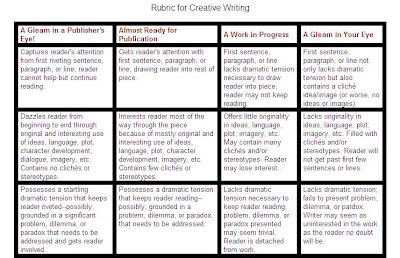
But I couldn't help it; I think assessment is awesome and necessary, and I had a fantastic creative writing class this semester, so I decided to try it again. I asked them to create a self-assessment rubric for their writing, based on criteria that they thought would best measure the success or failure of their writing--so, this was not a rubric designed to fit all writing (as were some of the ones I showed them as examples, above), but one designed to help them evaluate whether they'd done the job with writing that they wanted to do. And I did the cover letter thing again, asking them to explain what they saw as their ultimate goal for their writing, what elements they privileged in their writing that would help them reach that goal, and what kind of audience they imagined for that kind of writing. I explicitly left room for them to go big or small with their writing goals--for them to aim their writing mainly toward their moms or themselves, or for them to write for a vast (paying) public. I wanted to make it clear that I didn't expect them all to go on and get MFAs or to all try for the big publishers. I wanted them to be realistic and also to think of what exactly they enjoyed about writing, and what the greatest fruition of that enjoyment would look like.
Then they designed rubrics that detailed what major elements they were shooting for and what their writing would look like at various levels of achieving that element. So, many chose elements like character, plot, and voice, but they also came up with others more specific to their goals: "ideas" for a writer who prioritized fiction that could change people's outlooks and improve social conditions, "shock" for a guy head over heels for Chuck Palahniuk, "message" for a Roman Catholic writer wanting to write interesting fiction for (but not necessarily about) Christians. All had particular goals in addition to more traditional aims, and talked about those goals specifically and well.
I've asked them for permission to post some of their rubrics here, and when I get the electronic copies back from them, I'll make another post looking at how they constructed their rubrics specifically for their own writing as well as how those rubrics could be widely applied.
So their final exam, I thought, was bound to be a fun one. We had just finished watching Bladerunner, and so I asked them to make their own Voight-Kampff test for differentiating humans from robots. In order to do so, obviously, they had to choose an aspect of human life that they felt was pretty demonstrably and reliably different from imitated life (as the Voight-Kampff attempts to do, relying on empathy). They were asked to write me a cover letter explaining why they chose the one aspect of human behavior that they did--how they reasoned through it and why they believed it could not be imitated. Many chose effective markers of behavior (compassion, humor, memory), but the great majority did not explain in a particularly convincing way how reliable that marker was as the basis for a test, and their tests themselves, for the most part, did not really live up to the consistency and rigor of even the Voight-Kampff, which is itself brought into question in the book and film. I expected this to an extent--I even had a brief essay exam the day of the final that asked them to justify, if they could, using their test to determine the life or death of an entity who might be human, and most said no. But I did want rigor, and I did want their tests to be an exercise in self-assessment--holding themselves up to a mirror and asking questions about how we "earn" the special rank of humans, how we demonstrate humanity or fail to demonstrate humanity in our behaviors.

Now, there was lots I could have done to improve those outcomes. I probably neglected to discuss with them the basics of test construction and concepts like reliability and validity. I've always kind of had a knack for constructing good tests, and it speaks to why I'm good at taking them--but of course everyone has not had the experience of gaming out a test, and many people have always seen tests as arbitrary and random. Sometimes they're right. So I definitely needed to explain the purpose and methodology of testing more, and to command a certain degree of rigor up front.
But there's another problem, a sociological problem, I've learned, with asking many people to conduct an assessment based on their own critieria. The problem is that they tend to choose criteria that they themselves can regularly live up to. But assessment should have a high performance end and a low performance end--when asked what one needs to do to be good at something one wants to be good at, to qualify as something one wants to be, most people tend to set the bar where they can consistently reach it. Thus they're pretty much always guaranteed to succeed, to fall in the "above average" category. It's the same logic that explains why students regularly rate their performance at about a B if asked--the idea is that pretty much anyone can be above average if they show up, do some things. The same was true of self-assessment in the case of this final exam; I asked them to examine what was required of humans to qualify as humans, and they answered, "We have to qualify?"
Naturally, it's uncomfortable to examine whether you qualify for something you considered a given. It's upsetting to consider that you may lose what you thought you always were if you fail to perform it.

But I couldn't help it; I think assessment is awesome and necessary, and I had a fantastic creative writing class this semester, so I decided to try it again. I asked them to create a self-assessment rubric for their writing, based on criteria that they thought would best measure the success or failure of their writing--so, this was not a rubric designed to fit all writing (as were some of the ones I showed them as examples, above), but one designed to help them evaluate whether they'd done the job with writing that they wanted to do. And I did the cover letter thing again, asking them to explain what they saw as their ultimate goal for their writing, what elements they privileged in their writing that would help them reach that goal, and what kind of audience they imagined for that kind of writing. I explicitly left room for them to go big or small with their writing goals--for them to aim their writing mainly toward their moms or themselves, or for them to write for a vast (paying) public. I wanted to make it clear that I didn't expect them all to go on and get MFAs or to all try for the big publishers. I wanted them to be realistic and also to think of what exactly they enjoyed about writing, and what the greatest fruition of that enjoyment would look like.
Then they designed rubrics that detailed what major elements they were shooting for and what their writing would look like at various levels of achieving that element. So, many chose elements like character, plot, and voice, but they also came up with others more specific to their goals: "ideas" for a writer who prioritized fiction that could change people's outlooks and improve social conditions, "shock" for a guy head over heels for Chuck Palahniuk, "message" for a Roman Catholic writer wanting to write interesting fiction for (but not necessarily about) Christians. All had particular goals in addition to more traditional aims, and talked about those goals specifically and well.
I've asked them for permission to post some of their rubrics here, and when I get the electronic copies back from them, I'll make another post looking at how they constructed their rubrics specifically for their own writing as well as how those rubrics could be widely applied.
Done teaching CW

Well, the semester is over. I taught creative writing (and so did Tracy) and now I'm done, possibly forever. (How sad!)
How did it go? Pretty well, I think. My students wrote and read more for me this semester than most of them probably had in the last year. I would have liked to make the class more rigorous in certain ways, but one thing I've learned is that students will collectively determine the difficulty of a writing class; call it sabotage if you want (sometimes it does feel that way) but they have the power of unconscious collective action: if nobody does something, then I guess I've got to accept it isn't getting done. It's hard to explain how this works if you haven't seen it.
One thing I'm glad of is that I taught them Helen DeWitt's The Last Samurai. People seemed to think this was a mistake, but when I asked my students on the last day of class only two or three out of twenty agreed -- which, when we're talking about one of the most formally complex and difficult novels of the decade, is a pretty good number. I suspected that students would appreciate and learn from the challenge, even if it took a month of reading to get through the book at a reasonable pace. (For contrast: I read it in two days, mostly the second. These are the sorts of things you wish you could demand of your students.) I feel vindicated in my choice. The book is so rich -- so complex in its use of different narrative strategies -- that I don't think a person could read it without learning more than most books even have to teach. If I teach CW again someday, I will teach that book.
Abe Smith's Whim Man Mammon was less popular with students, in a way that reveals the difference between my conception of young students and how they actually approach a creative writing class. It was my suspicion (based somewhat on ignorance, given my home-school education) that most of them would have never read poetry beyond, say, Shakespeare's sonnets, some John Donne, and maybe some really tame Wordsworth or other pastoral boredom. What I thought they wanted, then, was permission to strike out in new directions and do something wild: to make something of their own.
Some students responded really well to Abe Smith's poetry, but many seemed to find it too much; too much chaos, too much weirdness, too much sound, too little clear meaning. I connected these feelings to their requests for more lectures. I lectured slightly more during the class than I had expected based on their requests, and in the end they wanted more. Many of them were looking for an authority figure, for someone to tell them what great writing was. I'm resistant to this, but their overwhelmingly positive response to my various poetry exercises, all of which were focused on unlocking new ways of approaching poems in imitation of some writer or another, shows me I think the way forward. If I teach CW again at the introductory level, poetry will be approached mainly through exercises, and we will write it whenever we read it; beginning students have the training necessary to talk about fiction in a revealing way, but not so much with poetry, it seems. They're still working out what the hell it is. Which is the main thing they said they appreciated about Whim Man Mammon: if nothing else, they agreed it showed them another approach to writing. But maybe not one they wanted to spend two weeks on.
They said my weakest selections were the plays I chose. I don't agree with them here but certainly I'm less well-versed in plays (especially one-acts, which is all we read) and I was choosing from a single anthology, an approach I generally think leads to poorer results. I'll have to try to learn more about drama. Truth is I think it's a little crazy to do three genres in one semester. But I am glad I mixed the genres up, switching between them regularly: most instructors here seem to divide the genres carefully as with sheets of butcher paper, and I don't see many advantages to that apart from the production of an illusion of mastery, which is no advantage at all.
All in all I think the only reasonable response to a semester spent teaching creative writing is overwhelming gratitude. After a couple months it became normal, something I just did, a job, and that's fine, that's what routine does. I had other classes to think about too. But one of the key features of MFA culture, one of the features that will never cease to boggle my mind, is a feeling of entitlement: it's the terminal degree, and so when you get done with it you're qualified to teach, and so you should get to teach, and it should be CW. Not everyone thinks this, but you see it. The economics of this system would of course be madness -- with MFAs spreading like fungus, we're already far closer to this situation than makes any kind of financial sense.
The MFA is a bit of a scam. It's a scam by writing teachers on universities and, if you're paying for it, students as well. That doesn't make it a bad thing. It's a nice, sometimes noble scam, designed to help writers get a little time and money to do what they love (or, in the case of some instructors, a lot of both). But it does mean that if you benefit from the scam the only appropriate response is quiet appreciation. Teaching CW is a great thing. I'm really glad I got to do it. I hope I get to do it again someday. But if not, well, I was still really lucky. Lucky to have intervened in the lives of my students. Lucky to have known them. Lucky, now, to let them go out and do what they will in their art.
Saturday, December 11, 2010
Amber Sparks' rules for writing
Amber Sparks was kind enough to send us a list of her rules for writing for our ongoing series. Have you got a list? Consider sending it along. Amber's list is below.
Rules, or constraints, whatever you want to call them--I've got tons. They're fluid and they change all the time, sometimes from piece to piece depending on what I'm trying to achieve. But I have to have them. They work on me like a belt, or a harness, or maybe even a straightjacket; they keep my molecules all stuck together, keep bits of me from floating off in every direction. They keep me focused.
I'm a very scattered person naturally, and while I count it a point of pride that I keep my shit more or less together, it takes a Herculean effort ( and lots of lists) to make it happen. Same with my writing. Maybe it inhibits creativity a bit, but I could never be one of those auto-writer types, the ones who can just let their minds wander and jot it all down. I'm jealous of them, how their brains work. I require structure, structure, structure.
The other problem that constraints help me avoid: I not only let my darlings live, I write them over and over again. To stop myself doing this, i have to declare some subjects off limit. Some general rules I'm following these days, in no particular order:
0. Every story needs an outline first. Even flashes.
1. No proper names. (Sometimes I'll name characters later. But I feel oddly trapped by
names while writing the story.)
2. Something has to happen in the story. (Yes, this actually has to be forced upon me.)
3. No wives or girlfriends that turn into, or are compared to, birds.
4. No normal physical descriptors. (Brown hair, green eyes, etc)
5. No quote marks. Little dialogue.
6. Limit adjectives to one, certainly no more than two per sentence. (I fail here often.)
7. No adverbs, if possible.
8. No specific, existing and recognizable places as settings.
9. No flashbacks.
10. No dreams.
11. No first person singular, if at all possible.
12. No writers. (As characters.)
13. Keep paragraphs shortish.
14. No checking email, Facebook, Twitter, or the work Blackberry more than once an
hour.
15. When stuck, open a book of poetry and choose a word at random; insert it and carry
on from there.
16. Write the title last, not first.
17. Cut. And cut again. And again. And again. Revise, revise. More.
18. Don't send a piece out the same day you wrote it.
19. Don't compare yourself to anyone. While writing, exist alone.
20. No music with words. Only instrumental (usually Dixieland jazz, ragtime, gypsy, etc).
21. No current events.
22. Break some rules or every rule and write a damn good story.
*
Rules, or constraints, whatever you want to call them--I've got tons. They're fluid and they change all the time, sometimes from piece to piece depending on what I'm trying to achieve. But I have to have them. They work on me like a belt, or a harness, or maybe even a straightjacket; they keep my molecules all stuck together, keep bits of me from floating off in every direction. They keep me focused.
I'm a very scattered person naturally, and while I count it a point of pride that I keep my shit more or less together, it takes a Herculean effort ( and lots of lists) to make it happen. Same with my writing. Maybe it inhibits creativity a bit, but I could never be one of those auto-writer types, the ones who can just let their minds wander and jot it all down. I'm jealous of them, how their brains work. I require structure, structure, structure.
The other problem that constraints help me avoid: I not only let my darlings live, I write them over and over again. To stop myself doing this, i have to declare some subjects off limit. Some general rules I'm following these days, in no particular order:
0. Every story needs an outline first. Even flashes.
1. No proper names. (Sometimes I'll name characters later. But I feel oddly trapped by
names while writing the story.)
2. Something has to happen in the story. (Yes, this actually has to be forced upon me.)
3. No wives or girlfriends that turn into, or are compared to, birds.
4. No normal physical descriptors. (Brown hair, green eyes, etc)
5. No quote marks. Little dialogue.
6. Limit adjectives to one, certainly no more than two per sentence. (I fail here often.)
7. No adverbs, if possible.
8. No specific, existing and recognizable places as settings.
9. No flashbacks.
10. No dreams.
11. No first person singular, if at all possible.
12. No writers. (As characters.)
13. Keep paragraphs shortish.
14. No checking email, Facebook, Twitter, or the work Blackberry more than once an
hour.
15. When stuck, open a book of poetry and choose a word at random; insert it and carry
on from there.
16. Write the title last, not first.
17. Cut. And cut again. And again. And again. Revise, revise. More.
18. Don't send a piece out the same day you wrote it.
19. Don't compare yourself to anyone. While writing, exist alone.
20. No music with words. Only instrumental (usually Dixieland jazz, ragtime, gypsy, etc).
21. No current events.
22. Break some rules or every rule and write a damn good story.
Qaeda Quality Question Quickly Quickly Quiet
Qaeda Quality Question Quickly Quickly Quiet from Will Guzzardi on Vimeo.
This video by Lenka Clayton, originally published by Wag's Revue, is pretty damn brilliant.
Friday, December 10, 2010
Rules for reading

In terms of selecting books, I have some trouble finding a method that consistently works. If I hear about an author say a hundred times I will often get a book from the library or buy one cheap. I don't have a lot of money or time for readings of personal choice (because I spend so much time and money reading stuff for school) so I tend to be pretty protective of my reading time. Sometimes someone will mention something on HTMLGiant and the mood will strike me or I'll see a friend is reading something. Sometimes I just want to spend some money and I see something on Amazon.
Once I find a writer I really love I try to compromise between the desire to read everything he or she ever wrote and the desire to read him or her for the rest of my life. In the case of Vonnegut I've read most of what's out there but I'm saving a few. (I got this idea from John Irving, who if memory serves is saving a particular Dickens novel for some time near death.) I could easily read everything Kelly Link has done to this point but I want to know there will be more later. This can lead to weird gaps in my reading but I'm okay with that.
Once I've chosen a book I have to deal with the increasingly difficult problem of how to physically manage the book. In the case of small ones, like say Kamby Bolongo Mean River, I can just sit there on the couch and hold it the way you're supposed to, maybe even in one hand. But my hands shake all the time and they get especially troubled when in delicate positions like the "book claw," so sometimes I'll just sort of hurl the book to the floor by mistake.
If the book is a big one I get into trouble because it can be too much to hold it up. But putting it on my lap doesn't work. And I have to sit up to read -- these days I find it way too easy to drift off, even if I'm really enjoying the book. So I can't lie down the way I did in high school, say, with Kavalier & Clay. My buddy and frequent commenter Ryan has suggested putting a pillow or a board on my lap, and this can work, but I'm a really, really warm person. Like, people sit down after me on a chair and they feel uncomfortably hot. So if I put something extra on my lap I end up sweating uncomfortably. This has become a real problem for me, it's one of the reasons I'm hoping to get a kindle sometime soon. I think that for some of the big books I hope to read over the next few years, it's pretty much my only hope.
I used to listen to music while I read (and watch TV, and use the Internet, and who knows) but increasingly I want to do it in silence. I can eat while I read. I like to have a drink nearby.
I need good light. I need to have a little air circulation if possible to keep my body alive and aware. Reading by a window can be nice.
I used to only read in long blocks of say 2-6 hours and this is still my preference but often now I have to content myself with reading fifty pages here and fifty there. Fifty pages is the unit I prefer to work in, because it makes me feel like I'm making progress so I don't give up but I know I can manage it fairly quickly.
Thursday, December 9, 2010
The Master's Workshop
 |
| For those of you wondering what this spaceman is doing here, his name is "Master Chief." |
The best thing about this semester has easily been what NMSU calls "the master's workshop." (I feel I have to put this in quotes because the idea I've mastered anything here is pretty laughable. Hopefully I have achieved competence.) This has been in fact possibly the best thing about the MFA. There have been times I've doubted this whole exercise was worth it, and in the case of many MFAs I imagine I would have concluded this was so. NMSU is unusual, however, in that it has a third year wherein most of the student's time and energy is devoted to revising and refining his or her thesis. Most people write collections. In this year's fiction class, three of five students wrote novels, Tracy and myself included.
It's been really stunning to me how much of a difference working on a whole book makes. Doubtless part of the power of this experience is that we've gotten to know each other's work so well -- I imagine I could write a pretty convincing imitation of anyone in my year -- but the difference is largely in the sheer amount of text present. If you read say six or seven hundred sentences in a particular style by a writer you might know something about how that person works and how they might do it better. Reading, say, 450 pages worth (as my fellows had to do in the case of my novel) or 800 (as we did in the case of another) or, more commonly, 120-220 pages, really clarifies the issues at play. The discussion has been tremendous, thanks in part to the smallness of the class, our relative closeness and investment in each other's work, and as a result I think all of us have significantly increased our odds of producing something of lasting work. Revising my book (again) is an exciting process. We also owe a lot to our instructor Craig Holden, whose practicality and focus have been extremely helpful. The dude gets structure. Which is, as it turns out, pretty important.
Honestly this workshop has pretty much saved the MFA experience for me. Which isn't surprising, really; I've always considered myself much stronger as a novelist (and as a reader of novels) than as a short story writer (and as a reader of short stories). We'll be doing it again in the spring. I doubt it'll be as good an experience -- we've got half the time to go over this stuff and no time at all to do anything about our discussion before the thesis defense -- but that's okay. If you're considering an MFA and you can find a program that fits your needs and has a similar three-year structure, I would recommend it.
The Fiction of Originality
[This started out as a comment to Tim's post, but I hate the comment box's confines -- in a very literal sense, I couldn't see my argument past the third line.]
"Originality" is, I think, a disingenuous concept, particularly in regards to the creation of art (which is, by its very nature, not "original" at all, but simulacrum). I would argue that many, many, many of our contemporary American short story writers, most of whom would likely turn up their noses at explicit appropriation and/or retelling a la Seth Grahame-Smith take not just "part of [their stories'] soul[s]" from Chekhov and (Dubliners era) Joyce (not to mention Freud), but lift sentiment and aesthetic wholly from those writers and their works without giving it a second thought. Whether or not they concede the point, they are retelling Chekhov and Joyce (and Freud, always Freud) and all of the writers who themselves were retelling Chekhov and Joyce and Freud. Why do we need that retelling? What exactly is the point, when we have Chekhov and Joyce and Freud?
We writers are all dealing with the very small set of emotions that can be conveyed by the written word. We are all retelling the small set of experiences that comprise human existence. There is a lifetime of stuff out there to do and think for each and every one of us, but, in the aggregate (and over the course of human history), it doesn't amount to much. There is nothing new under the sun. Plot points, characters and all fundamental elements have all already been used, somewhere, in some form, by someone. We make our small adjustments and call it "original," and I have no problem with that so long as it is understood as a provisional originality, an asterisk as it were, but to then delineate that from a "retelling" is, I feel, to fail to see that, at the very least, we are always retelling our experiences in the world, our thoughts and our attitudes towards these thoughts, all also fictions that we tell ourselves in order to navigate our everyday existences. Fictions, I might add, that we navigate in part through our engagement with other fictions: our education, upbringing, folklore, even the advice and opinion that we give and receive on the most mundane things, like which tires to buy and how to change them. Remember, Christians and Jews, that God made you in his image, a retelling from the start, and that our present understanding of what makes us human rests in large part on a science (AI) that is back-engineering this original retelling through what is itself a retelling by scientists and philosophers.
My point, in case it was buried in the various strands of argument, is that, whether we realize it or not, when we sit down to write, our tools, the sentences and characters and images we put down on the page are appropriations from somewhere else, retellings of something or other. Write what you know, right? Writers know books. Visual artists know visual art. Musicians know music. To ask them to disregard their particular field of expertise, the part of their lives they have presumably lived to the fullest, when it is time to create is to tie their hands behind their back. Joyce's Ulysses did not spring Athena-like from his brain (or Dionysus-like from his thigh); it came from Homer, at least in part. Homer (if he existed and wasn't just himself an aggregate) got the good word from somebody else. Isn't it at least a little suspicious that, the further back we go in the history of literature (Homer, for instance, or Pound's beloved troubadours, or Shakespeare), the more questions of authorship are raised? I don't mean "who wrote this?" in a Barthes sense (or maybe I do, also), but rather the doubt that any one person wrote it at all, much the person or persons we mean when we speak or write those names. Literature becomes collective the further back in history we go, appropriation less an aesthetic consideration than simply a fact.
Appropriation, it seems to me, is taking an existing thing and putting it into a new context. Retelling is clothing a preexisting story in new details. In terms of originality, it doesn't make any difference if these borrowed elements are characters taken from history or fiction, structure, form, language, fabula, sujet, etc. This is, on a very simple level, what we do when we write. Some writers acknowledge their debts, others don't. I don't really view one as more honorable or more valuable than another. (To come back to my earlier question) Why do we need that retelling, if literature is, as Ezra Pound (an appropriator himself) said, "news that stays news?" Because the elements that we appropriate and reappropriate are important. The fact that they are reused is the artist's way of assigning importance to them. There is nothing ignoble or cynical in this. It is in our nature. It is very necessary.
Rewrite, or, I Still Hate Christmas
I don't remember how I came to it (apologies if it was through your blog, or tweet, or etc.) but yesterday I saw the trailer for Rare Exports. It is almost too ridiculous to be real:
I watched the trailer in my office without volume and then, at home, with, for Sarah's amusement. Then I became actually interested in seeing this movie. Usually the so-bad-it's-ironically-good thing turns me off but this film seems to have just enough weird life that it might be a pleasantly unique experience. Here's a promising bit of the synospis, from the official website:
How do you feel about retellings, updates, stories inspired by other stories? My feeling, just in typing that sentence, was one of almost revulsion, this squeamish originality-loving fear, but I realize that I've enjoyed lots of stories inspired by others, and will continue to do so. Have you ever created something that took part of its soul from another creation? I don't mean just some nebulous spiritual inspiration but actual plot points, or characters, or other fundamental elements.
I watched the trailer in my office without volume and then, at home, with, for Sarah's amusement. Then I became actually interested in seeing this movie. Usually the so-bad-it's-ironically-good thing turns me off but this film seems to have just enough weird life that it might be a pleasantly unique experience. Here's a promising bit of the synospis, from the official website:
Pietari and his father Rauno . . . attempt to sell Santa to the misguided leader of the multinational corporation sponsoring the dig. Santa's elves, however, will stop at nothing to free their fearless leader from captivity.What I like about this (aside from how seriously the film seems to take itself) is how it takes a small detail from the source story and does something unique and, in this case, scary (watch the trailer) with it. Success in retellings seems to hinge, to some degree, on how closely the creators engage with the little details. Little details are what make a story more than just an entertaining narrative outline, especially in a retelling, where it's so easy to let the major points carry the story; it's the small things barely remembered that strike us as surprising and impressive, maybe because of the ease with which they could have been missed.
How do you feel about retellings, updates, stories inspired by other stories? My feeling, just in typing that sentence, was one of almost revulsion, this squeamish originality-loving fear, but I realize that I've enjoyed lots of stories inspired by others, and will continue to do so. Have you ever created something that took part of its soul from another creation? I don't mean just some nebulous spiritual inspiration but actual plot points, or characters, or other fundamental elements.
Wednesday, December 8, 2010
Maim Someone: Rules for Writing
Since Mike brought up the subject of rules in writing, I've been trying to figure out my own. I thought about them on a plane and in another state. I thought about them in a graveyard at one in the morning with a bleeding shin. I thought about them over taco lunch today and figured out what some of them were:
1) Wear shoes. I can't write anything without shoes. This is not because my office floor is tiled and freezing right now but because I like to feel like I could leap up and, using the desk for support, kick someone in the sternum if I needed to. I like to feel like I could run around in a field in case I need to write about running around in a field. Writing is sort of martial for me, I mean, certainly more martial than domestic, at least when it's going well, and I like to feel a little ready to move.
2) Don't let personal pet phrases leak into dialogue. I'm pretty good about this but occasionally as I edit I'll see something that a character would never say but that I would say. Come on, now, I think at those times. Come on, come on.
3) Pour the action all over the characters. I used to write lyrical chapters wherein people loafed around or chased their thoughts and my narratives went nowhere or at least nowhere interesting or at least nowhere interesting that anyone was going to follow along to. I'm in a phase now where I want as much to happen in as small amount of space as possible. With the last novel I wrote I worried I'd tear too fast through the story and collapse at 35k words but I made it to low 70s and everything feels full and right and I'm looking forward to finding things that don't seem full and filling them out. Puff. (That's me blowing air into them. Good air.)
4) If even remotely appropriate, maim someone. This goes back to number three. I used to be afraid to hurt my characters in any way and nothing felt endangered or important. Now I gouge out eyes, throw bottles, wreck cars. They get fingers cut off and they get mutated. Bad things happen, I mean. Well, they should. They do out here, on this side of the computer screen.
Tuesday, December 7, 2010
The Process

I live in Tuscaloosa, Alabama, home of the Alabama Crimson Tide football team (Roll Tide). When Nick Saban took over the head coaching responsibilities of the team he preached the idea of 'The Process'--that in order to be successful, players needed to focus on the process of playing football more than the results: the amount of effort put into practice and preparation and existing in the moment is more important than the final result. As is typical of a football-frenzied town, this became an integral part of the Tuscaloosa lexicon: t-shirts were made, existential conversations about 'journeys' and 'rewards' were being held at breakfast tables and rib joints all across Western Alabama.
When Mike e-mailed me and asked me about what my rules of writing were, I immediately thought about 'The Process'--that as long as I followed my own set of guidelines while writing, I would feel content in what I had created, and as a result the end product would be something that I would feel proud of. And so, here are some wacky quirks that I adhere to--some are specific to my current project of writing about 8-bit Nintendo games, but others are universal in just about everything that I write.
1. I don't write anything down/have a notebook. Every year a family member buys me a fancy looking leather-bound journal for Christmas that sits on a bookshelf empty and collecting dust. There's a lot of pressure to write in something that pretty, and I feel as if I'd inevitably screw it up. When I was younger I had a hard-covered Moleskine that I wrote maybe 40 words in--no idea what those words were, but damn, they must've been important. Instead, I have a really impressive array of folders and sub folders on my laptop--each essay has its own folder with a number of Microsoft Word documents that have spots for notes, free-writing, and the final product. Furthermore, if I am struck by inspiration while not at my computer, I will text it to myself. Have had zero problems with this except when I get inspired during a reading: it's all good if you write down notes during a reading, but to pull out your phone and start texting is a major faux-pas.
2. All of my writing is typed. On occasion I'll write some things down when I assign some in-class writing to my Creative Writing students and will type that up later, but for the most part, if I am in 'writing mode' I am at my computer. I once had a conversation with the amazing Rikki DuCornet about her writing process: she sits in her chaise lounge and just writes and writes on non-ruled paper. She then gives her writing to someone to type up for her. I joked that I should do the opposite: type up my stuff and pay someone to hand-write it for me. She didn't get the joke. I type in Cambria. I like it. Garamond is so played out and I like serifs.
3. Before I write about a videogame, I must play the videogame again. Ideally, I would own the game and play it on the console, but I'll track it down online and play it via emulator most of the time. Ideally, I will beat it. If I can't beat it, I will watch someone online beat it. I'll pay careful attention to the text in the game, as well as the different worlds in which the player is interacting with. I will also find out as much information about the game as possible: was it released in Japan under a different name? When was it released? Was it released in the arcade first? Did it spawn any sequels/is it a remake?
4. Before I write, I will listen to pop songs. I am obsessed with declarative and simple sentences, and all pop music lyrics are is pretty much that. I like turn of phrases: you can cry when you get older...you don't have to change.
5. No music when I'm writing. F that noise. The TV can be on behind me, but no sound.
6. All of my browser tabs will remain open. Someone can gChat or Facebook chat if they want to. I won't respond. There's something scary and ceremonious about 'shutting down Firefox to write'. I don't want any pomp or circumstance. That'd just mess me up.
7. When I'm sitting down to write something new or continue work on something, I must read everything that is within that sequence over again. This puts me in the writing rhythm. Of course this is easy when I've just started a project, but as I near the end of a project, I'm sitting there and reading for quite some time before I actually write anything down. This is also part of my editing process: if something doesn't feel right, I can make changes right there.
8. When I'm writing, everything must logically make sense (like what Gabriel discussed in his post). Every sentence must answer for the previous one.
9. Basic rules: no use of the word flesh. No use of the word kudzu. M-dashes, colons allowed. I used to use a lot of semi-colons and question marks, but not anymore. No proper nouns except for the days of the week/months.
10. When I am done with a first draft, I will read it aloud. This confuses my roommate. If something get stuck in my mouth, it gets cut. I will usually do this three or four times until I consider it 'done'.
11. During my writing process, I'll stand up for no particular reason and look at myself in the mirror. Maybe I'll put some clothes on hangers. Maybe I'll go get a Diet Cherry Dr. Pepper.
12. I like to write before I have somewhere to go/somewhere to be. Part of this is that it gives me a deadline and forces my hand. I think we all spend so much time complaining about not having any time to write that when we finally do have some time, we go ahead and decide to do something else. This way I'm like 'I'm meeting a friend for dinner at 7, so I better start writing now.' If I'm in a position where I have the whole day to write, I won't even get started. Thursdays are good days: I have a standing dinner reservation with my good friend & amazing writer Luke Southworth--we go eat barbecue at 7pm--something we jokingly call 'The Process'. So I know I have to be finished by 7. The only issue with this is that after I'm done writing I am exhausted and on a different planet for at least a little while and my social skills are minimal. Fortunately, Luke is like this as well, and so we can space out, eat pulled pork and talk about sports. I went on a date once after writing for three hours. That was a miserable failure--I still feel terrible about that.
13. After a writing session, I need to decompress and talk about writing with a handful of close friends (Luke is one of them). Usually nothing specific, just the fact that, wow, I just wrote a bunch today, and damn, I feel awesome and exhausted. Sometimes a tweet will do--some way to let the world know that I can come down from this manic writing episode and become a functioning member of society again. Sometimes I have to immediately send the draft to my friend Jeremy Hawkins so that it doesn't burn a hole in my computer--not necessarily for feedback, but just to create some more distance between myself and the act of writing.
All of this stuff is important--but above all else, I write to devastate. I'm absolutely fascinated by the idea that a combination of words can make someone feel something: can make them laugh, can make them think, can make them upset. I want people to feel something--there's no way I can make someone feel how I felt about a particular instance: but I can make people feel what I felt while writing about it. That it took everything I had to expel this out of me, and that these are the only words in which I can convey this information and emotion to the reader. If I feel like I've been punched in the stomach and then given a big hug, I know I've done something right.
Subscribe to:
Posts (Atom)